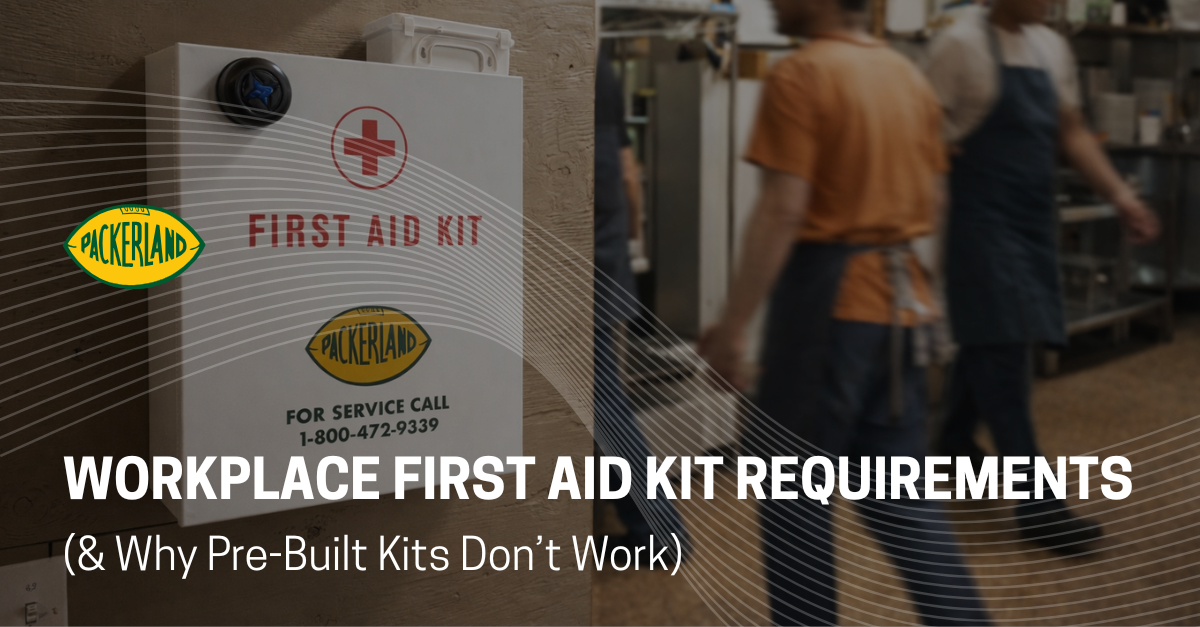
Most First Aid Kits Are Built to Check a Box—Not Handle Reality
Let’s be honest for a second.
Most workplace first aid kits exist for one reason: So you can say you have one.
That’s it.
Same box.
Same contents.
Same setup—whether you run a restaurant, a warehouse, or an office.
And somehow… that’s considered “good enough.”
But when something actually happens?
That’s when “good enough” falls apart.
What OSHA Actually Requires (And What Most Businesses Miss)
Here’s where things get interesting:
According to Occupational Safety and Health Administration (OSHA), there is no universal list of required first aid kit contents.
Instead, under standards like 29 CFR 1910.151 and 1926.50, workplace first aid kit requirements depend on:
- Workplace hazards
- Number of employees
- Accessibility to medical care
- Type of work being performed
Translation: Your workplace first aid kit requirements are specific to your environment.
There’s no template.
You can’t just use a prebuilt box.
And definitely can’t just send an employee out to the store with a list.
Different Industries Require Different First Aid Kits
What you really need – not just for compliance, but for actually treating an injury – depends on your industry and environment.
Restaurants & Commercial Kitchens
You’re dealing with a fast pace, sharp tools, and food regulations that make it all even more complicated.
This is where “standard kits” fail immediately.
You need:
- Blue detectable bandages
- Burn gel and treatment
- Finger cots and gloves
- High-frequency restocking
This is where the details really matter, because if a regular, tan-colored bandage falls into food, you may never find it. (Gross.)
That’s not just a safety issue—
that’s a liability issue.

Warehouses & Manufacturing
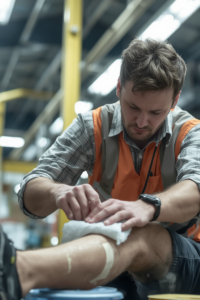
When you work in warehouses and manufacturing plants, risk escalates quickly. You’re not dealing with papercuts and minor injuries, you’re dealing with the risk of causing major bodily damage that can seriously impact your employees’ lives – or worse.
Accidents and injuries like:
- Heavy equipment injuries
- Eye hazards
- Impact and crush risks
You need:
- Eye wash solutions
- Compression bandages
- Cold packs
- Splints and wraps
A basic office kit here isn’t just insufficient… It’s dangerous.
Offices & Retail Spaces
These may seem to be “lower risk” jobs, but that doesn’t mean they are low consequence.
Because the biggest threat here usually isn’t a paper cut.
It’s sudden cardiac arrest.
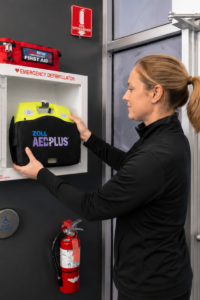
According to the American Heart Association, survival rates decrease 7–10% per minute without defibrillation. But 9 out of 10 people who receive a shock from an AED within the first minute of cardiac arrest survive it.
AEDs (Automated External Defibrillators) matter, yet most workplaces don’t have one available on site. When most people think about first aid, they just think about the kit that holds band aids. But what about the kit that holds the power to save a life?
That gap is bigger than most people realize.
Schools, Apartments & Public-Facing Spaces
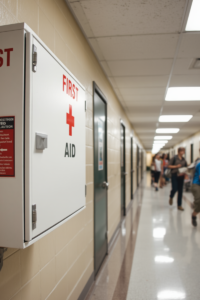
You’re dealing with a lot of people on a daily basis; Employees. Visitors. Families. Kids. The truth is, there are bound to be some really unpredictable situations. But just because they are unpredictable doesn’t mean that you can’t prepare for them.
You need:
- Clearly accessible kits
- Supplies for a wide range of situations
- Allergy response readiness
- AED placement based on response time
Because in these environments, seconds matter and preparedness is everything.
The Real Problem: Kits Don’t Reflect Actual Usage
Let’s do a quick reality check.
Open your first aid kit.
What do you see?
- Items you never use (fully stocked)
- Items you need (completely gone)
- Expired supplies still sitting there
But don’t feel bad; This happens everywhere.
Because most first aid systems for businesses are built around “good enough” – not real needs or true usage.
The “Small Fill” Problem (And Why It Adds Up Fast)
This is where most businesses tell us they’ve finally had enough with “The Big Guys”.
A technician shows up.
Opens your kit.
Adds a few bandaids to an already open box.
Then logs it as a service.
And bills for it.
Sometimes it’s labeled:
- “Small fill”
- “Service visit”
- “Maintenance check”
Either way, you’re paying for the visit, led to believe your first aid kit is stocked and compliant—not realizing that it’s barely enough for a skinned knee.
Multiply that over a year? Those end up being some really expensive bandaids.
A Smarter First Aid Kit Strategy
A real first aid program should be built for your industry, but adapt to your business.
It should answer questions like:
- What do you actually go through every week?
- What gets used the fastest?
- What’s missing that should be there?
- What risks are unique to your environment?
Because:
- Kitchens shouldn’t run out of blue bandages
- Warehouses shouldn’t be short on eye wash
- Offices shouldn’t be unprepared for cardiac events
This isn’t complicated, it’s just not how most systems are built.
Restocking Is About Risk—Not Routine
First aid isn’t something you think about every day, but when you need it?
There’s no time to:
- Check inventory
- Order supplies
- Realize something’s missing
You either have what you need… or you don’t.
According to the National Safety Council, workplace injuries happen every day across every industry.
Preparedness simply isn’t optional.
The Packerland Approach
At Packerland, first aid isn’t treated like a commodity.
It’s treated like part of your operation.
We:
- Track what you actually use
- Adjust inventory over time
- Build around your environment—not a template
Because when something happens, who you chose to partner with six months ago matters. That choice could be the difference between an injury being life-altering… or not.
That’s the difference between checking a box and actually being prepared.
Not sure if your current first aid kit actually meets your workplace requirements? We’d be happy to take a closer look.
What are workplace first aid kit requirements?
Workplace first aid kit requirements depend on hazards, workforce size, and environment. OSHA does not mandate a universal list but requires adequate supplies based on risk.
How often should a first aid kit be restocked?
It depends on usage and industry. High-risk environments may require frequent restocking, while low-risk workplaces still need regular monitoring to ensure readiness.
Are AEDs required in workplaces?
AEDs are not always legally required but are strongly recommended, especially in public or high-traffic environments, due to their impact on cardiac emergency survival rates.