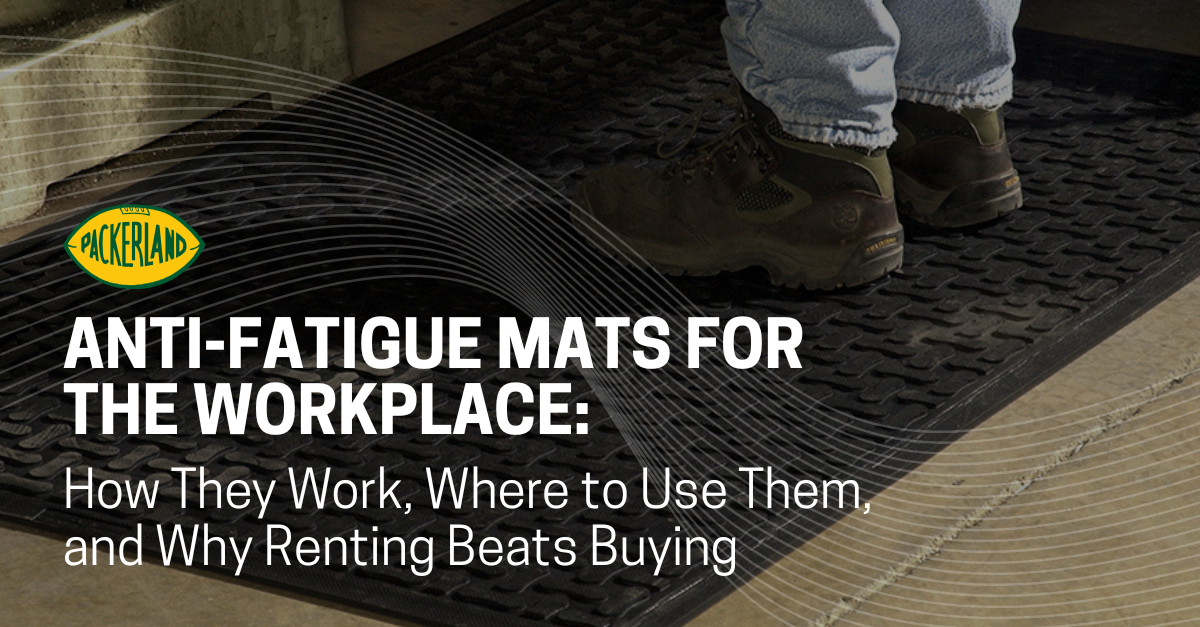
Anti-Fatigue Mats for the Workplace: How They Work, Where to Use Them, and Why Renting Beats Buying
Anti-fatigue mats are cushioned commercial floor mats that reduce the strain of standing for long periods on hard surfaces like concrete and tile. By gently compressing underfoot, they prompt small, continuous muscle movements that improve circulation and reduce pressure on the feet, knees, hips, and lower back.
That’s the technical answer.
Here’s the practical one: if your people stand all day, the floor is working against them. And most businesses don’t realize how much that costs until someone’s out on a workers’ comp claim.
Your Employees Are Standing on Concrete for Eight Hours. That’s the Problem.
Walk your floor tomorrow morning and watch how people stand.
You’ll see it immediately.
Weight shifted onto one hip. Knees locked. Someone leaning on the counter who wasn’t leaning on it at 8 a.m. A quick stretch of the lower back between tasks.
Nobody’s complaining. They’re just compensating.
And that’s exactly the problem — because compensating is what causes the damage. According to the National Institute for Occupational Safety and Health (NIOSH), there’s ample evidence that prolonged standing at work — defined as more than four hours a day, or more than an hour at a stretch — leads to negative health outcomes including low back pain, muscle fatigue, and leg swelling.
Your feet are the foundation. When they get tired, the load moves up: ankles, knees, hips, lower back. Each one picking up slack for the last.
Over a shift, that’s discomfort.
Over a year, that’s an injury.
The National Safety Council reports that U.S. private-sector employers logged more than 937,000 musculoskeletal disorder cases involving days away from work, job restriction, or transfer in 2023–2024. Those don’t all start with one dramatic incident. A lot of them start with a floor.
How Anti-Fatigue Mats Actually Work
Here’s the part most people get wrong: an anti-fatigue mat isn’t just a softer place to stand.
It works by creating movement.
The cushion compresses slightly under a person’s weight, which means the muscles in their feet and lower legs are making constant small adjustments all day long. That keeps blood moving instead of pooling in the legs. It takes static pressure off the joints. It’s low-level motion while standing perfectly still.
That’s also what separates a real anti-fatigue mat from the rest of your matting. Entrance mats trap dirt and moisture. Kitchen mats handle drainage and traction. Anti-fatigue mats are engineered for one job: keeping the person standing on them from breaking down over an eight-hour shift.
What you get out of it:
- Less pressure on feet and heels
- Less strain on knees, hips, and lower back
- Better standing posture through the back half of a shift
- Less fatigue — which means better focus, and fewer mistakes
- Added traction in most environments
A mat isn’t a substitute for good footwear, sit/stand options, or smart workstation design. But it’s the easiest piece to put in place, and it works on day one.
Does OSHA Require Anti-Fatigue Mats?
Short answer: no.
Longer answer: that’s not really the right question.
There’s no OSHA standard that says “you must provide anti-fatigue mats.” But two things make them a lot more than optional.
First, OSHA 1910.22 requires that where wet processes are used, employers provide drainage and — to the extent feasible — dry standing places such as false floors, platforms, and mats. If you run a kitchen, a wash bay, or a food processing line, that’s you.
Second, the General Duty Clause requires you to keep the workplace free from recognized hazards likely to cause harm. Prolonged standing on hard surfaces is a recognized ergonomic hazard. OSHA’s own ergonomics guidance recommends anti-fatigue mats for workers who stand for prolonged periods.
So: not mandated in most dry environments. But it’s a known hazard with a known, inexpensive fix — and regulators expect you to manage known hazards.
Where Anti-Fatigue Mats Belong
Anywhere someone stands in roughly the same square of floor for hours.
Manufacturing and industrial floors. Machine operators, assembly, packaging. Full shifts on concrete, often in the same footprint all day.
Commercial kitchens. Prep stations, the line, dish. Wet, greasy, fast — the one place where comfort and slip resistance have to come from the same mat.
Retail checkouts and service desks. Cashiers work a two-foot square for six hours. One mat covers the whole problem.
Healthcare. Nurses’ stations, pharmacy counters, lab benches. Twelve-hour shifts, mostly upright.
Warehouse and shipping stations. Packing, inspection, shipping counters. Standing plus repetitive motion is where fatigue compounds fastest.
Reception and front desks. Even people who alternate between sitting and standing benefit — and today’s mats look professional enough for a lobby.
Not sure which of your areas qualify? That’s what a walkthrough is for. We do them free.
Rent or Buy? Let’s Talk About What Actually Happens.
Buying looks cheaper. On the invoice, it is.
Then here’s what happens.
Three months in: the mat looks fine.
A year later: the cushion is compressed. It’s still on the floor, but it’s not doing anything anymore. Nobody notices, because a flat mat looks exactly like a good mat.
18 months: the edges are curling. Now the thing you bought to prevent injuries is a trip hazard.
Two years later: it’s greasy, it’s sliding, and somebody finally throws it out — and buys another one out of a capital budget that wasn’t planning for it.
That’s the buying cycle. Nobody’s tracking mat condition, because nobody’s job is tracking mat condition.
And Now Let’s Talk About “The Big Guys”
Renting solves that. But not all rental programs are the same, and this is where a lot of Wisconsin businesses tell us they’ve had enough.
The national providers will happily put mats on your floor. What they won’t do is look at them.
A route driver swaps the mats, logs the stop, bills the account, and moves on. Same mats, same schedule, same invoice — whether the cushion still works or not. Whether your operation changed or not. Whether that mat is even the right mat for that station or not.
You’re paying for a service. You’re getting a rotation.
What a Real Mat Program Looks Like
A floor mat rental and exchange service should do four things:
Replace mats that stop working. Not on a calendar. When the cushion is done, the mat is done — that’s the whole point of renting instead of buying.
Handle the cleaning. Our Route Service Representatives exchange soiled mats for clean ones on a set schedule. You don’t wash anything. You don’t store anything. In a kitchen, that alone justifies the program.
Keep it off your capital budget. A predictable monthly line item instead of a mat purchase every few years that nobody budgeted for.
Put the right mat in the right spot. Wet or dry. Greasy or clean. Heavy cart traffic or light foot traffic. Welding nearby or not. These aren’t the same mat, and pretending they are is how businesses end up with matting that doesn’t do its job.
And the mats themselves matter. We rent commercial-grade M+A Matting products, including Hog Heaven industrial anti-fatigue mats — solid nitrile rubber surface molded to a closed-cell cushion, grease and chemical resistant, and certified high-traction by the National Floor Safety Institute. Every mat we put down meets ADA specs and is NFSI certified. That’s not an upgrade. That’s the standard program.
How to Choose the Right Anti-Fatigue Mat
Match the mat to the station, not to a catalog photo. Before you pick anything, know:
- How many hours a day someone actually stands there
- Whether the area is wet, oily, or dry
- What traction the environment demands
- Whether carts roll across it
- Whether welding, chemicals, or static are in play
- How it’ll get cleaned, and how often
Then there’s material — and this is where cheap mats give themselves away. Nitrile rubber holds up. Vinyl and plastic curl at the edges and break down when grease hits them, which is how a comfort product turns into a safety problem. If there’s oil, grease, or chemicals anywhere near that station, nitrile isn’t a preference. It’s the requirement.
Frequently Asked Questions
Do anti-fatigue mats really work?
Yes. Anti-fatigue mats reduce the static muscle load and pressure of standing on hard surfaces by prompting continuous micro-movements that improve circulation. Ergonomics guidance from OSHA recommends anti-fatigue mats as an effective control for workers who stand for prolonged periods, especially when combined with supportive footwear and opportunities to change position.
How do anti-fatigue mats work?
The mat’s cushioning compresses slightly underfoot, creating subtle instability. Leg and foot muscles respond with constant small adjustments, which keeps blood moving, prevents pooling in the lower legs, and reduces the static pressure on joints that causes fatigue on rigid floors.
Are anti-fatigue mats required by OSHA?
There is no OSHA standard specifically requiring anti-fatigue mats. However, OSHA 1910.22 requires dry standing places such as mats where wet processes are used, and the General Duty Clause obligates employers to address recognized hazards, which includes the ergonomic risks of prolonged standing. OSHA’s ergonomics guidance recommends anti-fatigue mats for prolonged-standing tasks.
How long do anti-fatigue mats last?
Typically one to three years in commercial use, depending on traffic, environment, and mat quality. The cushioning compresses over time, and a compressed mat loses its ergonomic benefit. This wear cycle is a key reason many businesses rent mats with scheduled replacement rather than buying.
How do you clean anti-fatigue mats?
Most commercial anti-fatigue mats can be swept, hosed off, or mopped with mild detergent; grease-resistant kitchen mats need regular degreasing to maintain slip resistance. With a mat rental program, cleaning is handled for you — soiled mats are exchanged for freshly laundered ones on a set schedule.
What are anti-fatigue mats made of?
The best commercial anti-fatigue mats are made of nitrile rubber — a solid nitrile top surface permanently molded to a closed-cell rubber cushion, so the layers never separate. Nitrile rubber resists grease, oil, and chemicals, stays flexible without cracking or curling at the edges, and holds certified slip resistance. Cheaper vinyl and plastic mats tend to curl and degrade in greasy environments. The mats in our rental program are premium nitrile rubber construction, certified high-traction by the National Floor Safety Institute.
Do anti-fatigue mats help with back pain?
They can help reduce standing-related lower back strain. Because the body works as a connected chain, reducing fatigue at the feet lessens the compensating load that travels up through the knees and hips to the lower back. Mats work best alongside good footwear, posture, and position changes — they are a support, not a medical treatment.
Is it better to rent or buy anti-fatigue mats?
For most businesses with multiple standing workstations, renting is more practical. Rental includes professional cleaning and automatic replacement of worn mats, eliminates upfront cost, and ensures mats never degrade past the point of usefulness. Buying can make sense for a single low-traffic station where wear is minimal.
The Packerland Approach
We’ve been doing this since 1969 — when John Schultz Sr. was washing mats in his basement in Brookfield and delivering them out of the family station wagon.
Three generations later, the job hasn’t changed much. Put the right mat in the right place. Come back and check on it. Fix it before the customer has to ask.
That’s harder to scale than a route sheet, which is exactly why the national guys don’t do it.
We serve businesses across Wisconsin from our Appleton and Butler locations, and our customer list looks like a who’s who of Wisconsin business — including some we’ve served continuously since our very first year.
If your people are standing all day, let us walk your floor and tell you what we’d change. No obligation, no capital request, no pressure.
Contact Packerland Rent-A-Mat — or call 1-800-472-9339.